

Ever found yourself staring at a sprawling field and wondering just how much space you’re looking at? If you’ve ever tried to visualize an acre, you’re not alone. It’s one of those quirky measurements that can leave even the most seasoned landowners scratching their heads. Spoiler alert: it’s not just a random number thrown around by real estate agents.
Understanding Acres
An acre serves as a vital unit of measurement for land, often used in various contexts such as agriculture and real estate. Clarifying its definition and historical significance aids in better understanding this common measurement.
Definition of an Acre
An acre measures 43,560 square feet. This standard unit equals 4,840 square yards or about 0.405 hectares. When visualizing an acre, think of it as a rectangle that is roughly 208.7 feet long and 208.7 feet wide. Land usage often influences how an acre appears, whether it is a lush field or an urban lot.
Historical Context
Originally, the term “acre” derived from Old English, meaning “plow land.” Historically, it represented the area an ox could plow in one day. The acre’s definition evolved over centuries, becoming standardized in the 20th century. Various cultures have used the acre, making it a familiar measure in agricultural contexts worldwide.
How Many Feet Are in an Acre
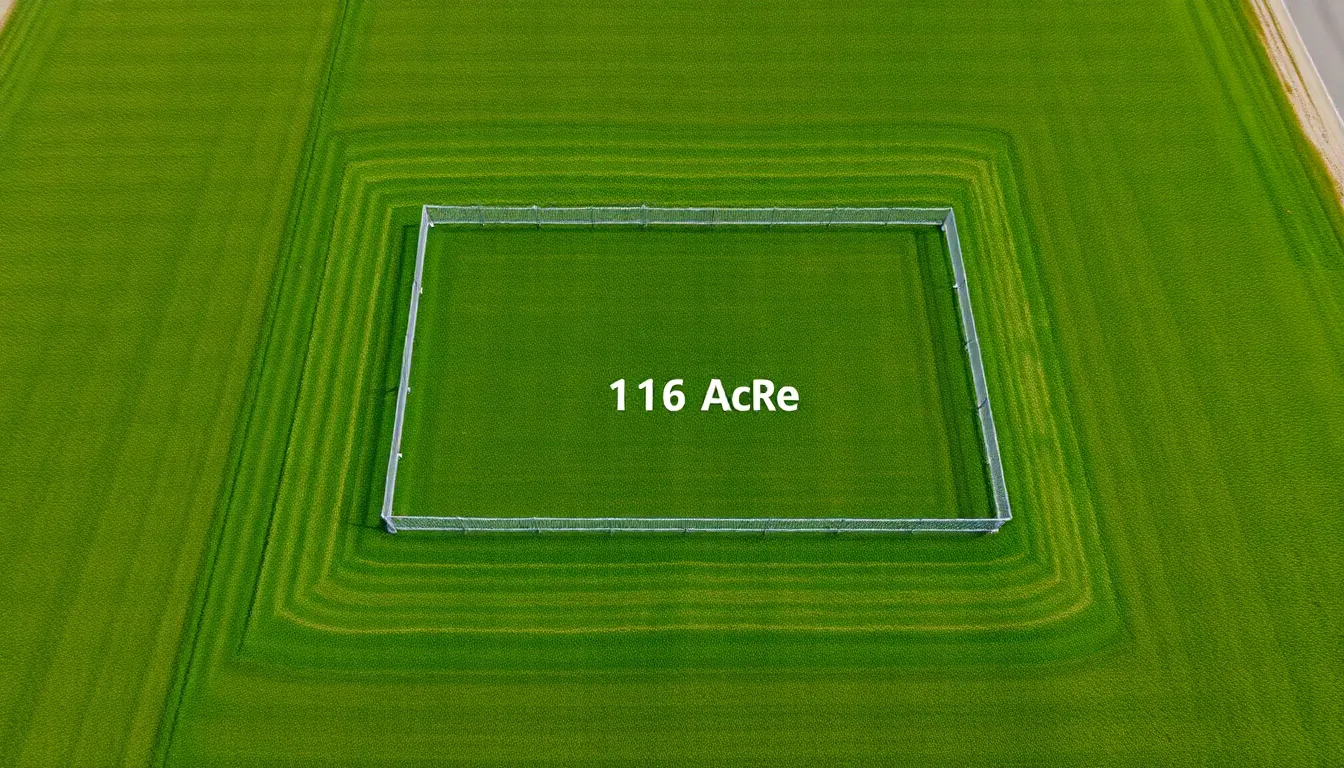
An acre measures precisely 43,560 square feet. This standard measurement remains crucial for land calculation in various contexts.
Exact Measurement of an Acre in Feet
An acre represents an area of 43,560 square feet, which translates to a square with each side measuring approximately 208.71 feet. This figure helps visualize the sheer size of an acre, enabling easier comprehension for real estate and agricultural purposes. It’s essential to note this measurement applies universally, providing a consistent basis for land assessments.
Conversion Factors
Conversion factors simplify understanding measurements related to an acre. One acre equals 4,840 square yards or 0.405 hectares. Various systems of measurement exist, but the acre maintains its significance across agricultural and real estate sectors. Knowing these conversion factors aids in comparing and understanding land size on a global scale.
Practical Applications
An acre, measuring 43,560 square feet, finds various practical applications in land assessment and agriculture. Its standardized size aids in precise evaluations critical for real estate transactions and farming practices.
Land Assessment and Real Estate
Real estate professionals rely on the acre’s specific measurement to determine property size effectively. Investors analyze multiple properties by comparing their acreages. Knowing an acre equals 43,560 square feet provides clarity during negotiations and appraisals. Urban planners also utilize this measurement when designing layouts for residential and commercial developments. Understanding acreage assists prospective buyers in visualizing parcel dimensions, facilitating informed decisions.
Agricultural Use
Farmers depend on the acre as a fundamental measurement for planning crops. Crop yields often correlate with the acreage cultivated. This unit enables agriculturalists to assess soil quality and land productivity effectively. Additionally, knowledge of an acre helps calculate the amount of seed, fertilizer, and water needed for optimal growth. Crop rotations and land management strategies benefit from understanding this essential measurement, ensuring sustainable farming practices.
Common Misconceptions
Misunderstandings about acres impact people’s perceptions of land size. An acre comprises 43,560 square feet, leading to confusion when compared with other measurements.
Misunderstanding Acre Measurements
Many people believe an acre can vary in size based on shape or location. In reality, an acre consistently measures 43,560 square feet regardless of its configuration. Common misinterpretations arise when individuals picture this measurement as less precise than it is. The standard size transforms how land is perceived in agriculture, real estate and urban planning contexts. Shapes such as rectangles, squares or even irregular forms can all equate to an acre, provided the total area remains constant. Recognizing this uniformity clarifies its importance across different applications.
Clarifying Footage Comparisons
People often struggle to visualize how 43,560 square feet compares to familiar areas. For instance, a football field typically has around 48,000 square feet, making it slightly larger than an acre. Visitors to parks or recreational areas frequently walk on similarly sized plots yet may not realize their acreage equivalence. This comparison demonstrates how large an acre really is. Additionally, envisioning an acre can become clearer when considering simple shapes, such as a square measuring about 208.7 feet on each side. Using everyday references enhances understanding, ensuring acreage knowledge translates into practical applications across various sectors.
Understanding how many feet are in an acre is essential for anyone involved in real estate or agriculture. With its precise measurement of 43,560 square feet, this unit plays a crucial role in land assessment and planning. By visualizing an acre in familiar terms, individuals can better grasp its significance and utility.
Whether it’s for negotiating property sizes or determining crop yields, knowing the acre’s dimensions helps streamline decisions in various sectors. As misconceptions about this measurement persist, clear knowledge empowers effective communication and understanding in land-related discussions. Embracing the concept of an acre can enhance one’s ability to navigate the complexities of land measurement with confidence.